Gilbert Blaine
H is for HawkGilbert Blaine is a falconry writer whose judgments help reveal how ideas about birds can reflect the social world of the people who train them. In the account presented by Helen Macdonald, he praises the Peregrine falcon as an ideal of power and grace while describing the goshawk as difficult and disagreeable. His authority is not merely technical: his writing gives a durable literary form to the hierarchy between the celebrated falcon and the disparaged hawk, a hierarchy Macdonald later questions.
Identity and Place in Falconry Writing
Blaine appears as Captain Gilbert Blaine, a published authority on falconry whose work Macdonald reads alongside earlier and later writing about hawks. A passage attributed to him in 1936 celebrates the Peregrine falcon as the most complete embodiment of power, speed, and grace. That praise establishes a standard of excellence, but Macdonald’s account also asks what social conditions made that standard seem self-evident. Blaine’s writing is therefore relevant both for what it says about birds and for the cultural assumptions its judgments carry.
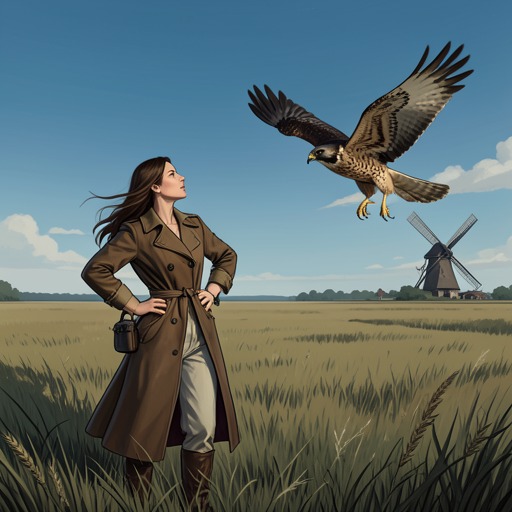
Falconry with Peregrine falcons required extensive open ground for their characteristic pursuit of quarry. Macdonald contrasts that requirement with the goshawk’s ability to dash from the fist at close range and hunt in more confined places. The difference made falconry with falcons more dependent on access to grouse moors, partridge estates, and large tracts of farmland—resources more available to wealthy or well-connected practitioners. Blaine explicitly associates possession of noble falcons among cultured peoples with aristocratic privilege. His account thus links the prestige of the bird to the restricted social access that made flying it possible.
Views of Goshawks
Blaine’s preference for falcons has a sharper counterpart in his writing about goshawks. He argues that a goshawk does not command the same respect or admiration as a Peregrine, and treats the names falconers give goshawks as signs of their character. In the later writers Macdonald surveys, the bird is repeatedly represented as sulky, contrary, or exasperating. Blaine’s description belongs to this tradition: it presents difficult behavior as an intrinsic disposition of the hawk rather than as a possible response to how it is handled.
Macdonald encounters these judgments while reading falconry books beside Mabel. A man she speaks with assumes that a woman training a female hawk must naturally get along with it. His remark prompts her to reject the idea that shared sex explains the relationship, then to examine what male falconry writers have said about female goshawks. Blaine’s characterization contributes to the pattern she finds: the hawk’s anger, refusal, or flight is treated as evidence of a naturally unreasonable temperament. Macdonald reads this language as gendered, because the bird’s moods are described through familiar stereotypes of female irrationality. Her point is not that Blaine’s text establishes a personal motive, but that its account participates in a wider habit of explaining conflict through the hawk’s supposed nature.
Earlier Accounts and Macdonald’s Reassessment
Macdonald sets Blaine’s opinion against seventeenth-century descriptions by Simon Latham and Edmund Bert. Those writers also recognized that goshawks could be shy and fearful, but connected their responses to rough treatment. They described birds that could become familiar and affectionate when handled with patience and consideration, and presented the falconer as responsible for meeting the hawk’s needs. Bert’s account of himself as the bird’s friend and playmate offers a markedly different model from the later image of the sulky, unmanageable goshawk.
This historical contrast changes the force of Blaine’s judgments. Macdonald does not simply replace one generalization with another: she considers how a hawk might behave differently under different forms of care. When she and Mabel play together with a rolled magazine, the bird’s curiosity and enjoyment unsettle the fixed picture Macdonald had inherited from books. She wonders whether such play had gone unrecorded because falconers had not played with their goshawks. Blaine’s writing becomes part of the received description that this small encounter complicates: what looks like a settled trait may also reflect what people have chosen to notice, encourage, or dismiss.
Connection with T. H. White
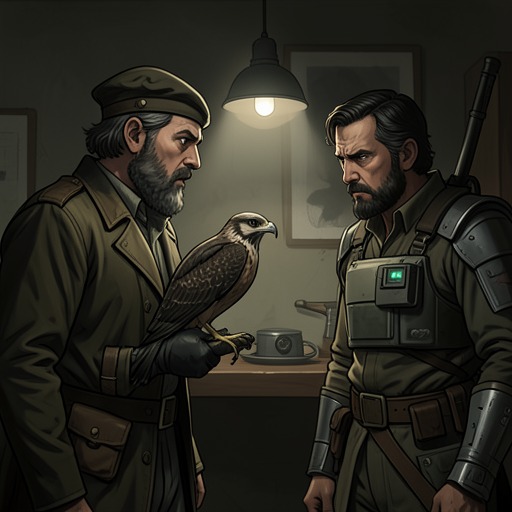
Blaine’s views also connect his writing to T. H. White’s experience with Gos. In a letter to White, Blaine explained that he disliked goshawks because their suspicious and erratic temperament had alienated him, as it had many falconers. Macdonald places that statement beside White’s later explanation that he loved Gos in part because the hawk was an outsider, difficult to teach and difficult to reach. The two men’s responses mark opposing possibilities within falconry: alienation from a bird regarded as troublesome, and attachment to the very qualities that make it resistant to easy possession.
Macdonald further considers how White’s bond with Gos allowed him to imagine forms of kinship and identity beyond ordinary social roles. This reading does not make Blaine a participant in White’s relationship with the hawk, nor does the evidence establish a fuller personal history for Blaine. Instead, the letter records a point of difference between their responses to goshawks. Blaine’s aversion helps define the prevailing difficulty that White’s attachment crossed, while Macdonald’s comparison makes both responses part of the book’s inquiry into how people interpret wild animals.
Significance
Blaine’s significance lies in the reach of his judgments across several themes in Macdonald’s account. His praise of falcons helps expose the connection between falconry’s prestige and unequal access to hunting land; his writing about goshawks illustrates how a bird’s behavior could be framed as an unchangeable defect; and his letter to White records the alienation that made White’s contrary attachment distinctive. These strands make Blaine less a fully narrated individual than a consequential voice in the history of falconry as Macdonald reconstructs it.
The contrast with earlier writers also prevents his position from appearing inevitable. Goshawks had not always been described as naturally disagreeable: accounts cited by Macdonald allowed for fear, self-will, affection, and a falconer’s responsibility to behave well. Blaine’s writing therefore helps her show that descriptions of animals are also records of human expectations. The bird’s reputation, the trainer’s conduct, and the social standing of the sport meet in the same argument, without reducing the hawk itself to any one human explanation.